No laser product has grown faster in fabrication shops than the handheld welder. The reason is not the technology itself, which has existed in automated form for decades, but what the handheld format does to a very old problem: skilled welders are scarce, expensive, and retiring faster than they are being replaced. This guide explains what the machine does well, how to choose a power class and cooling type, what the wire feeder adds, the safety rules that come with a handheld Class 4 beam, and where TIG still deserves the job.
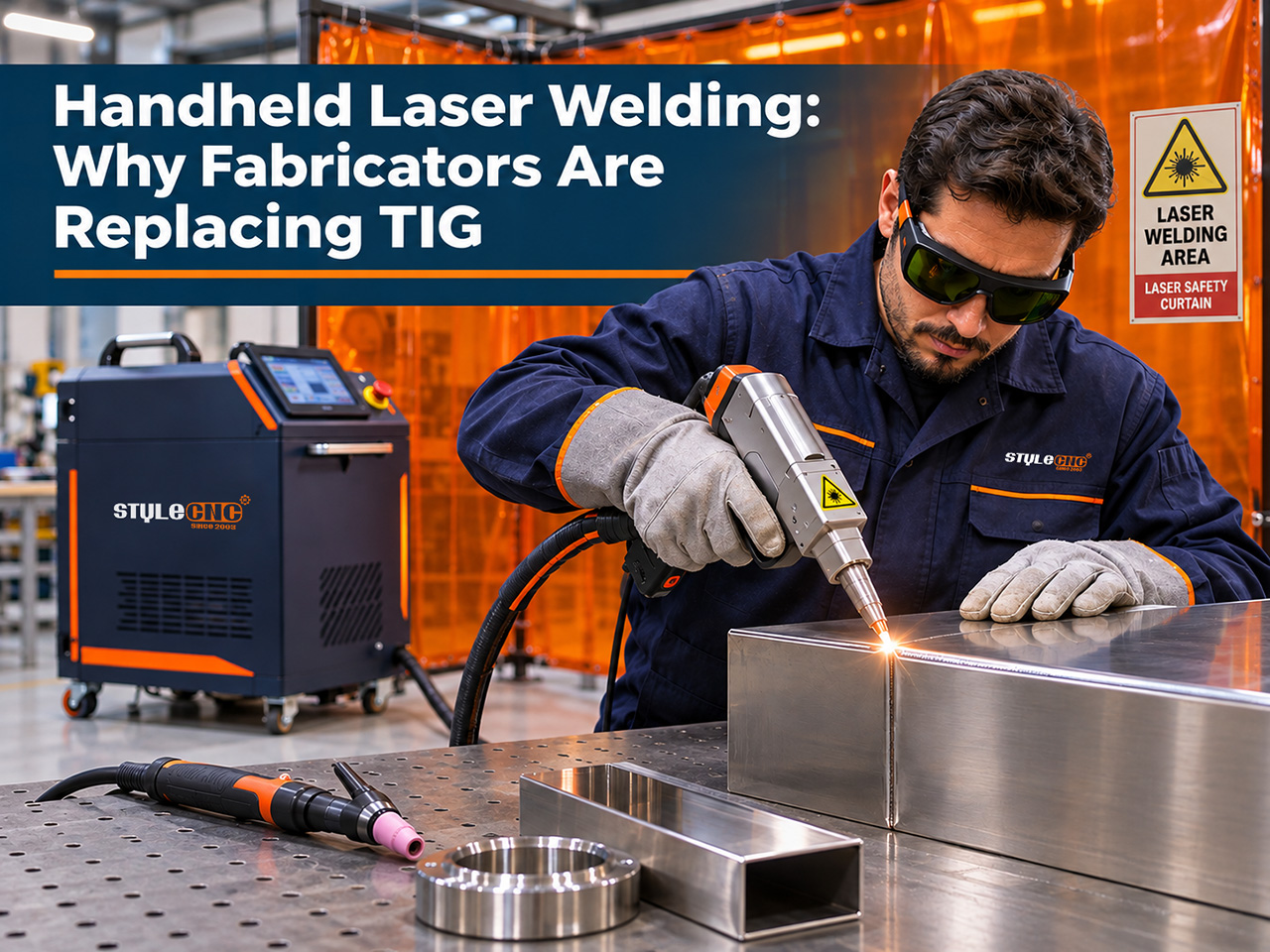
Why Handheld Laser Welding Took Over
3 advantages drive the shift, and each one attacks a different cost line:
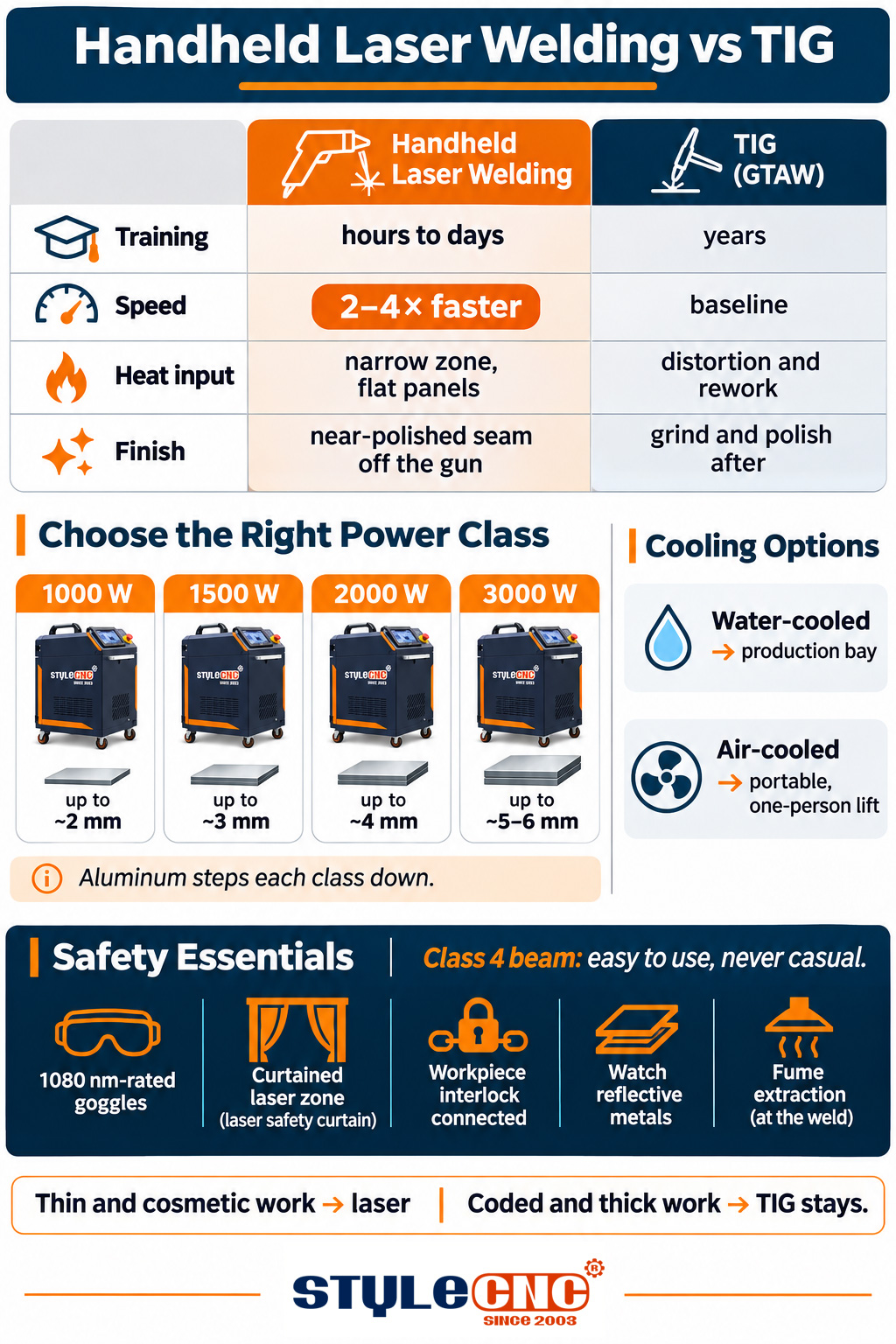
⦿ Training time: a careful operator produces acceptable seams on a handheld laser within hours and good production work within days; TIG proficiency on stainless and aluminum takes years to build.
⦿ Speed: on typical sheet work, laser welding runs roughly 2 to 4 times faster than TIG, because the beam delivers concentrated energy without waiting for a puddle to form and travel.
⦿ Heat input: the focused beam melts a narrow zone and moves on, so thin panels stay flat, colors stay clean on stainless, and the grinding and straightening that follow TIG largely disappear.
The downstream effect matters as much as the weld itself. Less heat means less distortion, which means less post-weld finishing, which is often where thin-sheet fabrication loses its margin. Shops describe the change plainly: the polishing bench went quiet the month the laser arrived. Seam appearance straight off the gun is close to a finished TIG weld, and the laser welding machine project gallery shows that finish across stainless, carbon steel, and aluminum work.
The format also changed those who buy táthairí léasair. Automated laser welding cells belonged to automotive and electronics plants with 6-figure budgets and robot programmers. The handheld gun put the same joining physics into the hands of a 2-person railing shop, a food equipment fabricator, and a mobile repair van, at a price closer to a good TIG setup than to a robot cell. That widening of the buyer base, more than any single specification, is what made this the fastest-growing laser product on the market.
Power Classes by Material Thickness
Power is the 1st specification to settle, and the honest rule is to buy for the thickness you weld weekly, not the thickest part you have ever seen:
| Aicme Cumhachta | Single-Pass Capability (steel) | Obair Thipiciúil | Fuarú | Tomhas |
|---|---|---|---|---|
| 1000 W | Thin sheet up to about 2 mm | HVAC, enclosures, light stainless fabrication | Uisce nó aer | Full penetration on your thinnest and thickest sheet |
| 1500 W | Suas le thart ar 3 mm | General fabrication, railings, kitchen equipment | Water; air-cooled models common here | Weld speed on a 1 m test seam |
| 2000 W | Suas le thart ar 4 mm | Job shops, repair work, aluminum up to ~3 mm | uisce | Penetration on a sectioned coupon |
| 3000 W | Up to about 5 to 6 mm | Heavy fabrication, thicker aluminum and steel | uisce | Duty cycle across a full shift |
Thickness capability also depends on joint fit-up, travel speed, and whether you accept multiple passes, so treat the figures as single-pass guidance on steel. Aluminum and copper reflect more of the beam and effectively step the machine down a class: a 2000 W unit behaves on aluminum roughly the way a 1500 W unit behaves on steel. The 1500 W and 2000 W classes dominate general fabrication because they cover the sheet range most shops actually see.
Water-Cooled vs Air-Cooled Portables
Traditional handheld welders pair the laser source with a water chiller, which adds a 2nd cabinet, coolant maintenance, and real w8 to move around. The newer generation of air-cooled machines removes the chiller entirely:
⦿ Air-cooled: a single compact case, often light enough for one person to lift into a van; ideal for site work, repairs, and shops that move the machine daily.
⦿ Water-cooled: higher sustained duty cycle and the full power range; the right choice for all-day production welding at a fixed station.
⦿ Climate matters: air-cooled units depend on ambient air, so a hot workshop clips their duty cycle sooner than a chilled water loop would.
The practical split is production versus mobility. A fixed welding bay running seams all shift favors a water-cooled 1500 to 2000 W machine; a maintenance team or site fabricator favors an air-cooled portable handheld laser welder that travels to the work. Many shops eventually run one of each.
What the Wire Feeder Adds
Autogenous laser welding, fusing the parent metal with no filler, demands tight fit-up because the narrow beam cannot bridge gaps the way a TIG puddle can. The wire feeder solves that. It pushes filler wire into the weld pool automatically, which lets the gun handle the imperfect gaps, outside corners, and fillet joints of real fabrication.
For most buyers the feeder is not optional. Order the machine with it, match wire diameter to your common thickness range, and expect to tune feed speed alongside power and travel speed. The gun motion itself, including the wobble setting that widens the seam, is easier shown than described; the walkthrough in how to use a handheld laser welding machine demonstrates the technique on real joints.
Shielding gas and consumables
Like TIG, laser welding shields the molten pool with gas, usually argon for general work and sometimes nitrogen on stainless. Plan a cylinder and regulator into the installation, and budget the small consumables that live at the gun tip: protective lenses, nozzles, and copper tips wear with use and cost little when changed on time. The quiet one is the protective lens; spatter clouds it gradually, and a clouded lens weakens the weld before anyone suspects the machine.
Safety: A Class 4 Beam in Your Hand
A handheld laser welder is a Class 4 laser device, and it deserves more respect than an arc welder, not less. The beam and its reflections can injure eyes at a distance, and unlike an arc, a stray laser reflection is invisible until it has done damage:
⦿ Eye protection: everyone in the laser area wears goggles rated for the source wavelength, around 1080 nm; ordinary welding shades do not protect against it.
⦿ Controlled area: weld inside a screened or curtained zone with warning signage, so reflections cannot reach passersby.
⦿ Interlocks: the gun's safety circuit must be connected to the workpiece clamp as designed; bypassing it defeats the system that stops the beam firing into open air.
⦿ Reflective targets: polished aluminum and copper bounce the beam; angle the gun and position screens accordingly.
⦿ Fume extraction: laser welding produces metal fume like any welding process, so extract at the source, especially on stainless and galvanized work.
Treat operator training as part of the installation, not an extra. The machine is easy to use, which is exactly why untrained hands pick it up; make the goggles-and-curtains rules as routine as the power switch.
Where TIG Still Wins
An honest guide says this plainly: the laser does not retire TIG everywhere.
⦿ Code and certified work: many procedures and certifications are written around TIG; requalifying a process takes time even when the laser weld is metallurgically excellent.
⦿ Very thick sections: multi-pass structural work beyond the single-pass range still favors arc processes.
⦿ Awkward access: a TIG torch reaches into corners and internal joints where a laser gun's nozzle and standoff cannot.
⦿ Exotic and critical metallurgy: titanium aerospace work and similar applications stay with the processes their procedures qualify.
For the broader physics behind these differences, the primer on laser welding fundamentals covers beam joining in more depth. The practical pattern in shops is coexistence: the laser takes the thin and cosmetic work, the arc keeps the thick and coded work, and both stay busy.
The Operator-Cost Argument
The economics usually close the decision. A certified TIG welder is a of the hardest hires in fabrication, and the wage reflects it. A handheld laser lets a semi-skilled operator produce clean seams on day one and production-quality work within a week, at 2 to 4 times TIG speed on sheet.
Run the arithmetic on your own numbers: the wage gap between a certified welder and a trained operator, multiplied by the hours of thin-sheet welding in a month, plus the finishing hours that lower heat input removes. For many shops that sum repays a mid-power handheld laser welding machine for metals within the 1st year, before counting the jobs won on faster turnaround. Owner experiences across shop sizes are collected in the laser welder customer reviews, and they are candid about both the learning curve and the payback.
Liosta Seiceála Ceannaitheora
✔ List your common materials and thicknesses, and pick the power class that covers the weekly work in one pass.
✔ Choose cooling by use pattern: water-cooled for a fixed production bay, air-cooled for mobility.
✔ Order the wire feeder and a starter set of nozzles, lenses, and goggles with the machine.
✔ Plan the laser-safe zone: curtains, signage, wavelength-rated goggles, and fume extraction.
✔ Weld your own sample joints before buying, and keep TIG qualified for the coded and thick work.
Put a Laser Welder in Your Shop
Compare power classes, cooling options, and wire feeders on the handheld laser welding machine for metals, and get a free quote matched to your materials, thicknesses, and daily welding hours.